
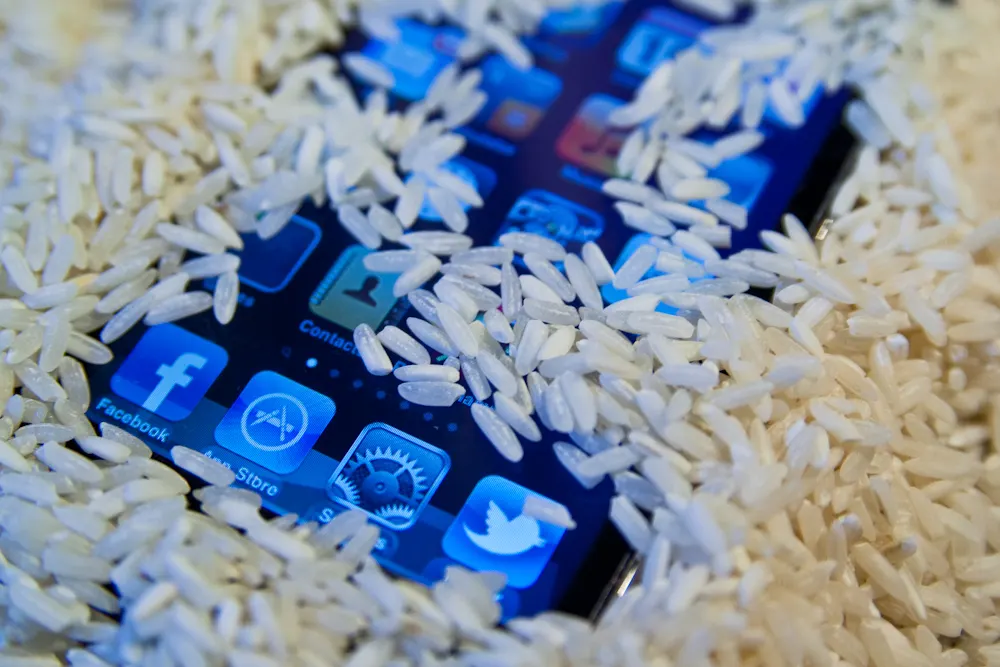
Every time someone drops a phone in water, someone nearby says "put it in rice." It is the most repeated piece of tech advice in India. At our Keshavpura shop, we probably hear about it five times a week. So let us be honest with you about what rice actually does, and what it does not do.
Why the Rice Advice Spread
Rice is a reasonable desiccant, it absorbs moisture from the air around it. In the right conditions, uncooked rice will slowly reduce the humidity in a sealed container. That much is true. The problem is that this property does not translate into effective phone drying for several important reasons.
Why Rice Does Not Work Well for Wet Phones
- The rice cannot reach inside the phone. Water damage is an internal problem. Liquid has entered the phone through small gaps and is sitting on the motherboard and components. Rice sitting around the outside of the phone cannot draw that moisture out efficiently through sealed seams and small openings.
- Desiccation is too slow. Corrosion from water damage begins within a few hours. The mineral salts in most water start oxidising copper traces and component pads quickly. Even if rice eventually absorbs some surface moisture after two days, the corrosion is already progressing inside during that time.
- Rice produces starch dust. Fine particles from the rice can enter the charging port, speaker grilles, and SIM tray, adding a new contamination problem to an existing one.
- It gives a false sense of action. This is perhaps the biggest harm. Putting the phone in rice feels like doing something, which delays the one thing that actually helps: getting the phone to a technician quickly. Many phones that could have been saved arrive at our shop two or three days later with advanced corrosion, and the customer says "I had it in rice."
What Actually Happens to a Wet Phone Over Time
Here is the timeline of what happens inside your phone after water exposure:
- 0-2 hours: Water is present but corrosion has not yet set in significantly. This is the best window to get the board professionally cleaned.
- 2-12 hours: Mineral deposits begin oxidising. Corrosion starts on copper pads and component legs. Still recoverable in most cases.
- 12-48 hours: Corrosion spreading. Some components may already be damaged. Recovery still possible but success rate decreasing.
- 48 hours+: Significant corrosion. Some components will have failed. Partial recovery is possible but complete recovery is much less likely.
During Kota's monsoon season, we see a clear pattern: phones brought to us within a few hours usually recover well. Phones that spent two days in rice often show extensive corrosion when we open them.
What You Should Actually Do
- Power the phone off immediately.
- Remove the case and SIM tray.
- Gently shake the phone port-side down to expel visible water.
- Pat the outside dry with a clean cloth.
- Bring it to a professional technician as fast as possible, within hours, not days.
If you cannot visit us immediately, the best you can do at home is leave the phone in a dry room with good airflow, ports facing downward, without powering it on. This is not ideal, but it is better than rice.
What We Do Instead of Rice
At our Keshavpura shop, we open the phone and clean the motherboard with isopropyl alcohol or in an ultrasonic cleaner designed for electronics. This physically removes the mineral deposits that cause corrosion. We then dry everything properly using controlled methods. This is the treatment that actually addresses the real problem: contamination inside the phone, not surface moisture.
| Method | Addresses internal corrosion? | Time to act |
|---|---|---|
| Rice bag | No | Delays help by 1-3 days |
| Hair dryer | No (and causes heat damage) | Immediate harm |
| Leaving to air dry | Partially, surface only | Too slow for corrosion |
| Professional board cleaning | Yes, removes deposits | Works best within 2-4 hours |
We are not sharing this to bring more business through the door, we are sharing it because we genuinely want you to have the best chance of saving your phone. The rice advice is widely repeated but it simply does not work well enough. Please come to us quickly instead.
Frequently Asked Questions
My phone survived after being in rice. Doesn't that prove it works?
Not really. Many phones survive minor water exposure on their own, regardless of what you put them in. The rice was present but was not the cause of survival. A phone that survived in rice would almost certainly have survived without rice too.
Are silica gel packets better than rice?
Yes, silica gel absorbs moisture more effectively than rice. But the same problem applies: it cannot reach inside the phone. It is a marginal improvement at best, and it does not replace professional cleaning.
Can I use isopropyl alcohol at home to clean the board?
We do not recommend this unless you have experience opening phones. Opening a phone incorrectly can cause additional damage, and improper application of alcohol can spread contamination rather than remove it.
My phone was in rice for three days and now shows odd behaviour. Is it fixable?
Bring it to us for a free check. Three days is a long time for corrosion to develop, but some repairs are still possible depending on what has been damaged. We will tell you honestly after inspecting it.
What if I drop my phone in salt water or the toilet?
These are worse than clean water because of the higher mineral content and contamination. The urgency is even greater, bring the phone to us as fast as possible. We have a separate article on phone-in-toilet steps specifically.
Frequently asked questions
My phone survived after being in rice. Does that not prove it works?
Many phones survive minor water exposure on their own. The rice was present but not the cause, the phone would likely have recovered without it.
Are silica gel packets better than rice?
Slightly better as a desiccant, but they still cannot reach inside the phone. Neither replaces professional board cleaning.
Can I use isopropyl alcohol at home?
We do not recommend opening the phone yourself unless you have experience. Improper application can spread contamination rather than remove it.
My phone was in rice for three days and is now behaving strangely. Is it fixable?
Bring it in for a free inspection. Three days allows significant corrosion, but partial repair is often still possible depending on what failed.
What if I dropped the phone in salt water or the toilet?
These liquids cause faster corrosion due to higher mineral or contamination content. The urgency is even greater, visit us immediately.
Questions & comments
Ask our Kota technicians anything about this repair. All posts are reviewed before they appear. For an urgent quote, WhatsApp us.
No comments yet, be the first to ask a question.
Leave a comment or ask a question
First, verify your email. We send a 6-digit code so we know you are a real person. Your email is never shown publicly.
Enter the 6-digit code we emailed to .